
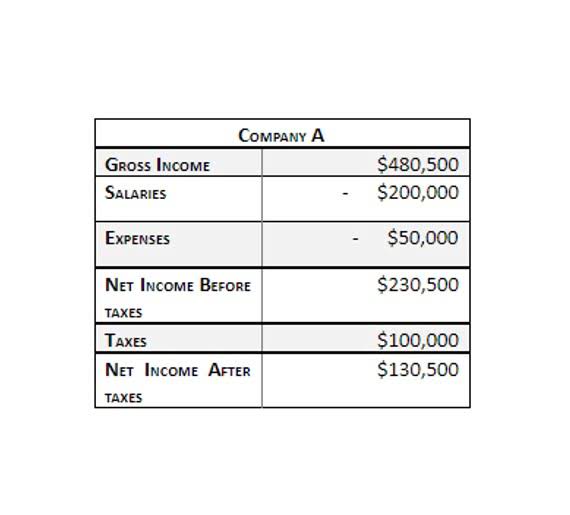
While the structure of costs may differ from product-based businesses, ROS is still a valuable indicator of how efficiently a service company runs. Divide their operating profit — $150,000 — by their net sales of $550,000. Without a clear picture of your operational efficiency, it’s impossible to know if your revenue is translating into real earnings. This leaves decision-makers blind to inefficiencies and vulnerable to poor forecasting, bad investments, and stagnant growth. Since we now have the two necessary inputs to calculate the ROS ratio – we can now divide the operating profit by sales to arrive at a return on sales of 30%.
What is ROS, and how is the ROS formula calculated in sales?
This metric helps a company manage its sales and marketing activities by measuring how effective they are at generating revenue. It also helps a company determine how much money should be spent on sales activities, based on the amount of profit generated by those sales activities. Market dynamics and competitive pressures significantly influence ROS. Companies operating in highly competitive markets may face pricing pressure, impacting their ability to maintain healthy profit margins.
What factors can impact a company’s return on sales ratio?
Return on sales (ROS) shows operating profit (EBIT) as a percentage of total sales. Operating return on sales, also known as operating margin, is a measure of a company’s profitability. It is calculated by dividing the company’s operating income by its total sales.
Best practices to improve return on sales
This profitability ratio is particularly useful when evaluating a potential investment opportunity because it allows you to compare companies within the same industry, regardless of their size. This is an ultimate guide on how to calculate Return on Sales (ROS) ratio with in-depth interpretation, analysis, and example. You will learn how to use its formula to evaluate a company’s profitability. Businesses can improve their return on sales by using AP automation software that includes self-service supplier onboarding. The same amount of sales could be made in less time and fewer sales could be lost with a smoother sales process. Since ROS is a measure of the efficiency of dollars from sales, anything from better qualification of leads to improving digital sales experiences can help increase it.
Comparing ROS with Other Profitability Metrics
- You can calculate this figure by dividing a company’s net profit after taxes and total net value of sales.
- Which includes the cost of goods sold, salaries, rent, and utilities.
- To streamline your sales process, you could cut back sales and marketing expenses to focus only on channels that consistently bring an above-average ROI.
- Now that we have a clearer picture of what constitutes a good ROS, let’s explore some actionable methods to improve your company’s Return on Sales and boost profitability.
- Keep in mind that the equation does not take into account non-operating activities like taxes and financing structure.
- Since most of the time generating additional revenues is much more difficult than cutting expenses, managers generally tend to reduce spending budgets to improve their profit ratio.
Several factors must be considered when determining a good return on sales. An increasing return on sales year-over-year means that your business is becoming more profitable. If the average return on sales for the industry is 15%, an ideal ratio is similar or higher. Decisions like these directly affect the operating margin ➡️ there’s a minimized mismatch between demand and supply.
- Revenue alone isn’t enough information to tell potential investors or lenders if a business is a good investment or loan opportunity.
- Lower ROS can mean the company is over-spending on marketing or production, or has too much debt.
- Proper stock optimization means increased cash flow and stronger financial statements for the company.
- Comparing a retailer’s ROS with that of a tech company would be misleading as it does not account for their unique operating environments.
It’s your job to be ultra-aware of what you’re spending on core operations and why. Regularly review the cost of software, supplies, manufacturing, and other operating expenses with your team. You can also use ROS to compare your company’s results with those of your competitors.
Proper stock optimization means increased cash flow and stronger financial statements for the company. return on sales Such pricing strategies directly influence net sales and affect both the company’s operating profit and net revenue. This doesn’t mean constant price fluctuations, but rather having a pulse on the market. For instance, retail businesses might have a lower ROS compared to tech companies due to different cost structures.
If you want to know how efficiently you’re turning over profit, you should understand what ROS is and how to calculate it yourself. The terms “return on sales” and “profit margin” are often used interchangeably, but those semantics are only partially accurate. There are different unearned revenue kinds of profit margins — only one of which is the same as return on sales. It can also be used to compare your company’s performance, relative to other companies.

Market dynamics and competitive pressures
Instead, analysts use combinations of ratios to track a company’s performance trends, benchmark it against peers, and identify potential risks or strengths. This feedback is a Retained Earnings on Balance Sheet goldmine for improving your offerings and boosting sales. Expanding into new markets involves identifying opportunities to sell products or services to customers in new regions or demographics. Streamlining operations involves identifying and eliminating unnecessary steps or processes in order to improve efficiency and reduce costs. It’s essential for investors and business partners when evaluating business performance, as it indicates the company’s ability to pay loans back, the potential for reinvestment, and potential dividends. Profitability is a key factor in the long-term success of any company.